
SLE Oral Test: How to Improve Your Listening Comprehension
If you’re preparing for the SLE oral exam as part of your federal government language requirements, you already know that it’s not just about speaking; it’s also about understanding. Your ability to grasp the nuances of French or English during the test is just as important as how you respond.
Before diving into listening strategies, make sure to read our previous guide on the SLE Oral Questions. It offers an excellent foundation for understanding the types of prompts and topics you’ll encounter during your second language oral evaluation. In this article, we’ll explore how to sharpen your listening skills, understand what examiners are looking for, and confidently handle every part of the oral SLE test.
Understanding the SLE Oral Exam Structure
The second language evaluation oral is officially known as the Public Service Commission’s (PSC) Oral Language Assessment (OLA). Its purpose is to evaluate your ability to communicate effectively in your second official language, most commonly French for English-speaking federal employees and vice versa.
The questions on the SLE oral test are based on realistic professional situations. You’ll engage in a guided conversation with an examiner, who will assess how well you can understand and respond in French or English. The evaluation measures three key competencies:
-
Comprehension : Understanding What’s Said (and Implied)
Can you accurately understand what’s being said, even when the language becomes complex or abstract? To ensure proper understanding, you need to analyze the context of the question as well as the intonation that highlights key elements. It’s about much more than just knowing the vocabulary.
-
Interaction: Keeping the Conversation Flowing Naturally
Can you maintain a conversation naturally, ask clarifying questions, and express ideas clearly?
-
Production: Expressing Ideas Clearly and Professionally
Can you use vocabulary and grammar appropriately to convey your message? Production is evaluated based on vocabulary precision, grammatical control, and the ability to adapt your language register to professional settings.
During the test, you’ll be asked different types of SLE oral test questions, each designed to test your ability to follow instructions, react to information, and discuss topics spontaneously. Together, these competencies form the foundation of the SLE oral test, guiding how examiners evaluate your real-life workplace communication skills.
Types of Questions in the SLE Oral Evaluation
The SLE oral evaluation follows a structured yet conversational format. Understanding the SLE oral question types ahead of time will make you feel more confident and focused. Here are some of the most common types of oral SLE test questions:
General information questions:
Simple questions to start the conversation, such as: « Quelles sont les qualités d’un bon gestionnaire ? » or « Est-il important de bien savoir communiquer au travail ? » It’s important to distinguish between personal and general questions. When responding to general questions, it’s best to avoid using personal examples.
Situational questions:
These test your ability to react to realistic work-related scenarios. For example, handling a client complaint or discussing project priorities.
Abstract or opinion-based questions:
These go beyond facts and assess your ability to express opinions and justify your reasoning, such as discussing teamwork, leadership, or challenges in your profession.
Hypothetical or Problem-Solving Questions:
These questions test your ability to think critically and use advanced structures like conditional or subjunctive forms. You might be asked, « Que feriez-vous si un collègue ne respectait pas une échéance importante? » or « Comment réagiriez-vous si votre gestionnaire vous demandait de prioriser un projet urgent? »
Each of these question types is designed to evaluate different linguistic and cognitive skills. The better you understand their purpose, the easier it is to tailor your listening and responses effectively.
What Examiners Look For in Your Responses
Examiners are trained to evaluate how well you listen and respond under real-world conditions. In the PSC Oral Language Assessment (OLA), comprehension isn’t just about translating words, it’s about showing that you truly understand meaning, context, and tone.
They’re listening for whether you can:
-
Follow the flow of conversation without needing frequent clarification.
-
Understand implied meanings or idiomatic expressions.
-
Respond spontaneously and maintain natural conversation flow.
Your listening comprehension directly affects your fluency and confidence. When you fully understand each question, it becomes easier to organize your thoughts and express only the relevant points. This helps the conversation flow more smoothly and naturally, which is an essential skill for reaching a C level.
Listening Comprehension Strategies for the SLE Oral Test
Improving SLE listening comprehension takes more than just passive exposure to French. You need active, structured listening strategies, especially for the public service bilingual oral exam Canada candidates face.
Here are some proven SLE listening comprehension strategies:
-
Train with authentic materials
Expose yourself to spoken French and English as it’s used in professional and everyday contexts. To mirror the tone and vocabulary of the public service bilingual oral exam Canada, try listening regularly to Radio-Canada Première, Les Coulisses du Pouvoir, or even La Presse audio articles.
- Débutant–Intermédiaire: Parlons français (CBC/Radio-Canada Learning Series), TV5Monde Apprendre le français
- Intermédiaire–Avancé: Radio-Canada Première, Les Coulisses du Pouvoir, Tout un matin, Le Téléjournal
- Advanced/Professional: La Presse audio articles, L’Actualité podcasts, Les Affaires business podcasts
These sources mimic the register and vocabulary you’ll hear during your second language evaluation oral Canada.
-
Use active listening techniques
When you listen, take brief notes, key words, verbs, and transition markers. Try predicting what the speaker will say next or summarizing after each segment. This trains your brain to focus on meaning rather than word-for-word translation.
-
Practice paraphrasing aloud
After listening to a short passage, rephrase it in your own words. This helps connect comprehension with expression, a crucial skill in the oral SLE test.
-
Identify linking words
Recognizing linking words helps you follow the logic of spoken French/English more easily.
Common examples include:
- En fait → “In fact / actually”
- Par contre → “On the other hand”
- Cependant → “However”
- Donc → “So / therefore”
- Bref → “In short”
- Par conséquent → “As a result”
- Enfin → “Finally / well”
Understanding these signals helps you anticipate what comes next in the conversation, a key to improving your SLE oral exam listening flow.
How to Improve Your Oral French for Government Exams
Your listening comprehension is directly linked to your speaking ability. The more accurately you understand what’s being asked, the more confidently you can respond during the SLE oral exam. Here are a few ways to strengthen your overall oral French proficiency:
-
Practice your second language as often as possible
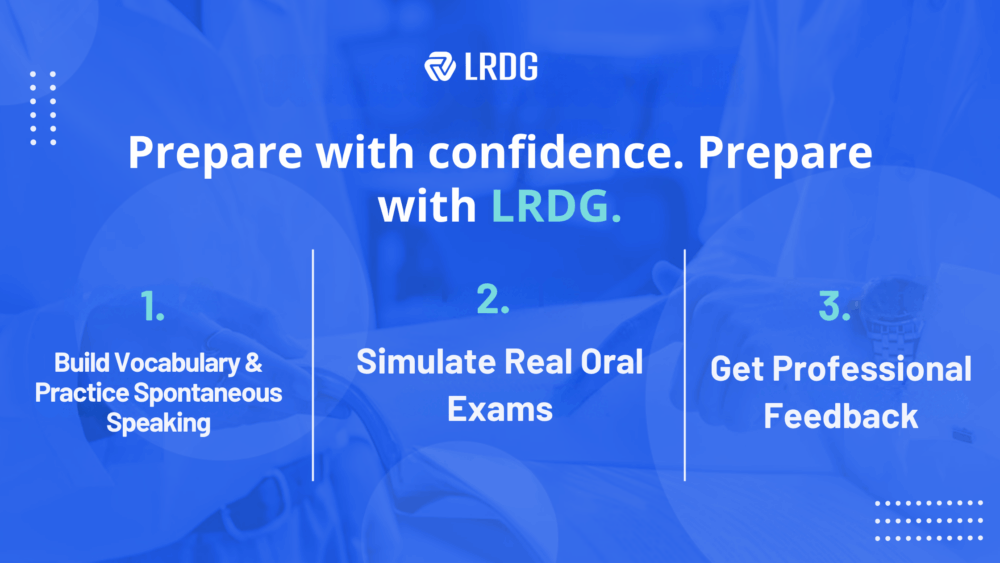
Regular exposure helps you internalize vocabulary, expressions, and pronunciation. If you don’t have colleagues or friends who speak French or English, LRDG can pair you with a qualified tutor to help you build consistent language habits and maintain momentum in your learning.
-
Simulate Real Interviews with LRDG
The best way to prepare for the SLE oral interview format is to experience it. LRDG offers mock exams that replicate the PSC Oral Language Assessment (OLA) environment, giving you practical experience with real question patterns, timing, and examiner feedback.
-
Review common workplace vocabulary
Terms related to meetings, policies, project management, and client communication frequently appear in the oral SLE test.
-
Get professional feedback from Tutors and Advisors
One-on-one tutoring sessions with LRDG’s qualified tutors help you focus on your individual challenges, whether that’s listening comprehension, pronunciation, or building complex sentences. Our experts analyze your performance and guide you step by step toward success on your oral SLE exam.
Sample SLE Oral Test Questions to Practice
Here are a few examples of SLE oral test questions to help you prepare:
- Décrivez une situation où vous avez dû résoudre un conflit au travail.
- Comment gérez-vous plusieurs priorités en même temps ?
- Parlez-moi d’un projet dont vous êtes particulièrement fier.
- Que feriez-vous si un collègue n’était pas d’accord avec votre approche ?
When practicing these, pay attention not only to your vocabulary but also to your listening response. Imagine how an examiner might rephrase, challenge, or add follow-up details, then prepare to adapt your answer naturally.
Tips for Staying Confident During the SLE Interview
Confidence comes from preparation and mindset. Here are a few key tips for managing stress during your oral SLE test:
- Take a moment before answering: It’s completely normal to pause and think. It shows composure and helps you process the question fully.
- Clarify when needed: If you didn’t catch part of the question, ask politely for repetition. This shows professionalism, not weakness.
- Use transition phrases: Expressions like « c’est une excellente question » or « je dirais que », help buy time and maintain fluency.
- Focus on communication, not perfection: Examiners are looking for effective communication, not textbook grammar.
Remember, the goal is to demonstrate that you can perform your job duties in both official languages, not to sound like a native speaker.
Additional Resources to Prepare for the SLE Oral Assessment
To prepare well for the SLE oral exam, you need to be persistent, seize every opportunity to be in contact with the target language, and receive appropriate support.
- LRDG’s online French training programs: Tailored specifically for public service bilingual oral exam Canada candidates.
- Official PSC sample materials: Review the official Oral Language Assessment guide.
- One-on-one tutoring to refine your comprehension and oral fluency.
- SLE-specific training programs designed for public servants preparing for Levels A, B, or C.
- Mock exams that mirror real SLE oral test conditions.
- A complete library of SLE blogs, from beginner guides to advanced preparation tips; covering each section of the second language evaluation in detail.
Whether you’re just beginning your SLE preparation or aiming to upgrade your levels, LRDG’s expert guidance ensures you’re fully supported.
Final Thoughts
Improving your listening comprehension for the SLE oral test requires consistent practice, regular exposure to the target language, and the use of effective strategies. By engaging in active listening, familiarizing yourself with common question types, and practicing regularly, whether independently, through tutoring sessions, or with mock oral tests, you can build confidence and strengthen your overall performance.
At LRDG, we specialize in helping federal employees master the second language evaluation oral through personalized learning plans, expert coaching, and flexible online lessons. Explore our programs today to feel fully prepared for your SLE oral exam and beyond.
Book a call!
Sign up for tips to help you learn, pass your PSC tests and achieve your levels.
Get inspiration to keep you motivated!
"*" indicates required fields